
-
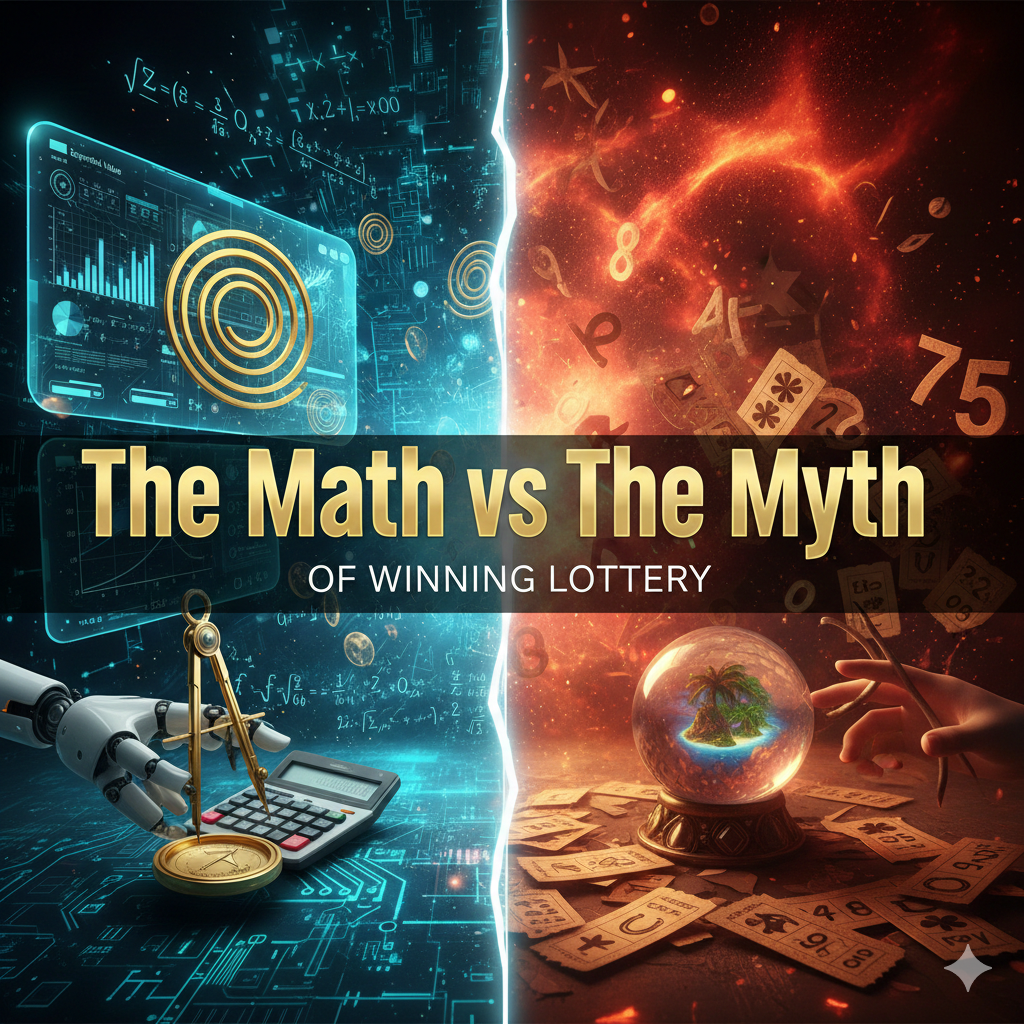
The Lottery: Cracking the Code or Chasing a Thief Ghost?
(The Math vs. The Myth of Winning)
The dream is universal: a winning lottery ticket, a life transformed. Millions flock to buy tickets each week, fueled by hope, a dollar, and perhaps a “lucky” feeling. But beneath the surface of this global phenomenon lies a fascinating tension between cold, hard math and the alluring myths we create. Can you genuinely employ a “strategy” in a game of pure chance? Let’s break it down.
Myth #1: The “Hot” or “Cold” Number Fallacy
The Myth: “Number 7 hasn’t come up in ages; it’s due!” or “Number 23 is on a roll; it’s a hot number!”
The Math: This is a classic example of the Gambler’s Fallacy. Each lottery drawing is an independent event, completely unrelated to previous drawings. The machine doesn’t remember which balls were picked last week, and the balls themselves have no memory. The probability of any specific number being drawn is exactly the same in every single drawing, regardless of its past performance.
Think of it like flipping a coin: if it lands on heads five times in a row, the probability of it landing on heads a sixth time is still 50/50. The coin doesn’t care about its “streak.”
Myth #2: Visual Patterns & “Lucky” Numbers Increase Your Odds
The Myth: “I always pick my birthday,” or “I pick numbers that form a diagonal on the ticket grid; that feels lucky.”
The Math: While picking your birthday or creating a visual pattern on your ticket might feel personal or lucky, it does absolutely nothing to change the microscopic odds of those numbers being drawn. The machine picks numbers randomly.
However, here’s where strategy does come in (not for winning, but for maximizing payout): Thousands of people pick birthdays (numbers 1-31), sequential numbers (like 1, 2, 3, 4, 5, 6), or simple patterns. If those “popular” numbers are drawn, you’ll likely split the jackpot with many other winners.
The Strategy (Math-Savvy Approach): To maximize your potential payout if you win, pick numbers that are less commonly chosen. This includes numbers above 31, and avoiding obvious sequences or patterns. While it doesn’t increase your chance of winning, it significantly decreases your chance of sharing the prize.
Myth #3: The Martingale System and Other “Guaranteed Win” Bets
The Myth: “If I double my bet every time I lose, I’ll eventually win back all my losses and make a profit!” (Often applied to roulette or coin flips, not lotteries directly).
The Math: The Martingale system (or similar “doubling-down” strategies) sounds tempting, but it’s a financial trap. It fails for two critical reasons:
-
Table Limits: Casinos (and even your own bankroll) have limits. Eventually, you’ll hit a point where you cannot afford to double your bet again.
-
Finite Bankroll: One sufficiently long losing streak (which is mathematically inevitable over enough trials) will completely wipe out your funds before you can ever recover.
While you might win small amounts frequently, the catastrophic loss that eventually occurs will erase all previous gains and more. It’s a strategy designed to eventually lead to “gambler’s ruin.”
The REAL Strategy: Playing with Positive Expected Value ($+EV$)
This is where the serious players (and even some academics) separate themselves from the dreamers. You cannot change the randomness of the draw, but you can change when and how you play to tilt the odds slightly in your favor or, more accurately, to increase your expected return.
The Strategy: Only play when the Expected Value ($EV$) of a ticket is positive.
-
What is EV? It’s the average outcome if you played the game thousands of times. If a ticket costs $2, but the average return (based on jackpot size, probability, and smaller prizes) is $2.50, then the $EV$ is positive.
-
The “Roll-Down” Loophole: Some lotteries have specific rules where, if the main jackpot isn’t hit for several weeks, the prize money “rolls down” and is distributed among winners of smaller prize tiers (e.g., matching 4 or 5 numbers instead of all 6). During these specific “roll-down” weeks, the mathematical $EV$ of buying a ticket can turn positive.
Case Study: Jerry and Marge Selbee – The Lottery Whistleblowers
Perhaps the most famous example of the $+EV$ strategy in action is Jerry and Marge Selbee. They discovered a lottery in Michigan (and later Massachusetts) called “Cash WinFall” that had a roll-down feature. They calculated that when the jackpot reached a certain threshold (typically around $5$ million), the total payout from the roll-down feature made every $1$ ticket effectively worth more than $1$.
They didn’t rely on luck; they relied on math. They formed a syndicate, buying hundreds of thousands of tickets during these specific “roll-down” weeks, and legally won over $26$ million over nearly a decade before the lottery was shut down due to their exploits. Their strategy wasn’t about picking winning numbers; it was about recognizing when the game itself offered a mathematical edge.
Conclusion: Can You “Beat” the Lottery?
In the traditional sense of consistently picking winning numbers, no. The lottery is a game of pure, unadulterated chance, and no amount of “strategy” will change the fundamental randomness of the draw.
However, if “beating” the lottery means:
-
Maximizing your potential individual payout by avoiding popular number choices.
-
Playing only when the mathematical odds of return are in your favor (Positive Expected Value).
Then, yes, a select few have shown that a purely mathematical approach, devoid of superstition, can turn a game of chance into an investment opportunity. It’s not about luck; it’s about understanding the system better than anyone else.
So, the next time you pick up a lottery ticket, remember: the real strategy isn’t in guessing the numbers, but in understanding the game itself.

 Have a cute cat